Production and processing


Espace Hamelin, 17 rue de l’Amiral Hamelin , 75116 PARIS
In 2015, primary aluminum production approached 60 million tonnes worldwide.
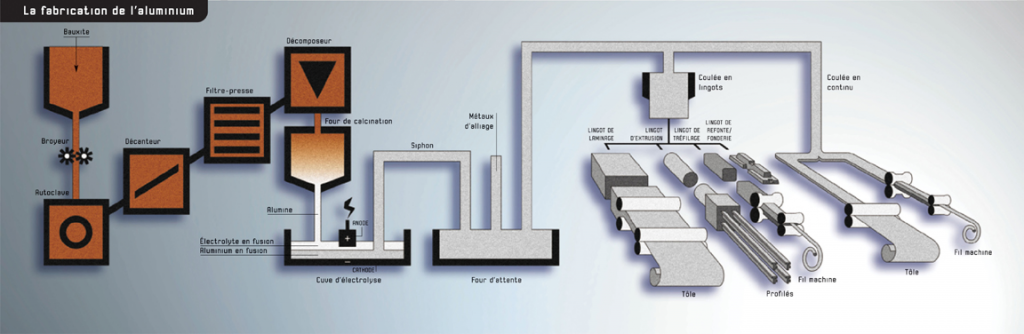
Some benchmarks for the production of primary aluminum: about 4 tonnes of bauxite are needed to obtain 2 tonnes of alumina, from which 1 tonne of aluminum is extracted by electrolysis
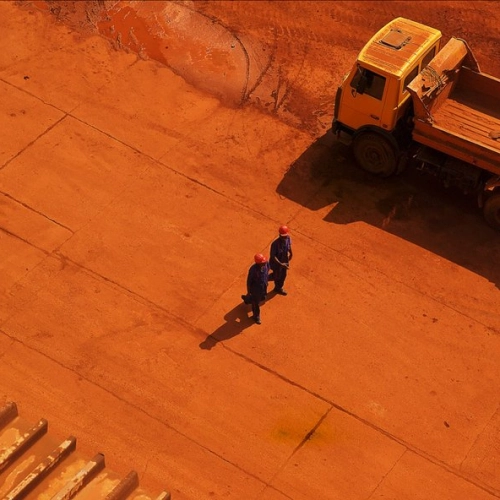
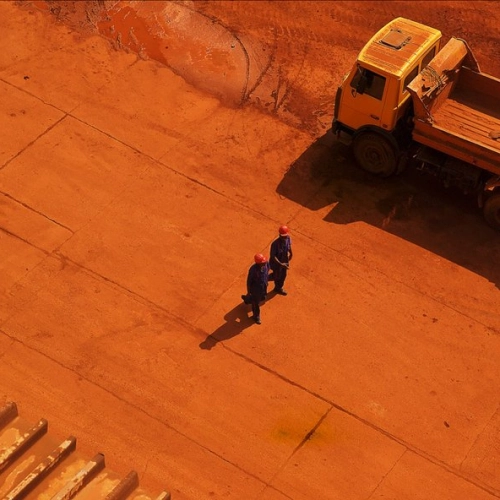
Aluminum constitutes 8% of the mass of the earth's crust, it does not appear in pure form, but as a composite mineral called bauxite. Bauxite is evenly distributed on the surface of the planet. This ore contains between 40 and 60% hydrated aluminum oxide, mixed with silica and iron oxide.The main mining reserves of bauxite with high alumina concentration are located in Central America, Africa and Australia.
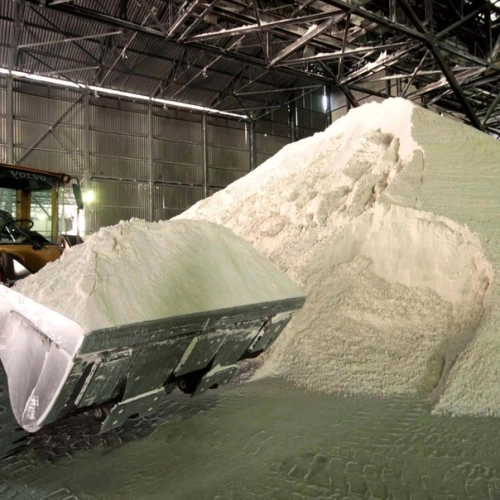
Bauxite is attacked by soda, at high temperature and under high pressure. The liquor obtained, sodium aluminate, is freed of its impurities, then diluted and cooled, which causes precipitation of hydrated aluminum oxide. A white powder, alumina, is then recovered. Most of the alumina (~ 90%) is used to produce the metal aluminum. The remaining 10%, sometimes called specialty alumina, have various non-metallurgical uses such as: water treatment, manufacture of refractory products, ceramics, abrasives, special glasses, etc. Alumina production is largely concentrated around ore extraction areas: Australia is the world's largest producer ahead of China and South America.
The alumina is then poured into a bath of cryolite and various salts, brought to 960 ° C., in order to be perfectly dissolved. A high intensity electric current passes through the tank. By this electrolysis process, the aluminum - positive ion - is deposited on the cathode - negative electrode. Liquid aluminum settles to the bottom of the tank. It is regularly sampled by siphoning and taken to a foundry to be treated and shaped. In France, two sites produce primary aluminum: Saint-Jean-de-Maurienne, the oldest factory in Europe (1907), and Dunkirk, the last factory built in Europe, in connection with the nuclear program.
A large part of the aluminum produced each year comes from recycling (60% in France) .Two distinct channels are used for recycling:
To learn more about recycling
Semi-finished products in aluminum and aluminum alloy are produced by rolling, extrusion or by foundry. These are the three main shaping processes. World consumption of semi-finished products is approximately 50% of total consumption. That of spun semi-finished products is around 25%.
Rolling is a continuous process of reducing the thickness of a metal plate by successive passes between rolls, in which the aluminum is both crushed and drawn. Starting from the foundry plate, approximately 50 cm thick, it is thus possible to obtain aluminum strips a few microns thick. There are two main stages in the production of aluminum rolls, hot rough rolling and cold finish rolling.

The transformation also takes place in the liquid state with the foundry, which represents a fairly diversified field of activity: automobile, handling equipment, industrial equipment, electrical equipment, aeronautics. It consists in pouring aluminum or a liquid alloy in a mold to reproduce, after cooling, a given part (internal and external shape) while limiting as much as possible subsequent finishing work.
Aluminum is the material of color, the one that offers the greatest freedom to the designer. Two main families of surface treatment are used: anodizing, a process exclusive to aluminum, and thermo-lacquering, a process which allows the material to be painted "for life".